
Weeknight cooking in a small rental kitchen usually means the same scene: a crowded counter, a cutting board balanced on the sink, and a fridge full of good intentions that turn into takeaway by Thursday. These small kitchen meal prep station ideas for renters fix that in about two hours on a Sunday. One small zone for chopping, one shelf of ready containers, and a routine that turns a tiny kitchen into a place where dinner mostly makes itself. Everything here is freestanding, removable and deposit-safe. No drilling, no fixed mounts, nothing to repair at move-out.
The rule is simple. A prep station only works if it is faster than ordering in. If washing, chopping and packing takes longer than the delivery app, the station dies by week two. So build it around your real habits: the counter you actually stand at, the containers you actually reach for, and the three or four meals you cook on repeat. Get those right and the rest follows.

Set Up Your Meal Prep Station Zone
The zone is the station. Pick one stretch of counter and protect it, because a prep area that doubles as a dumping ground will never get used.
1. Claim one counter zone and defend it. Choose the longest clear run of counter, ideally next to the sink and the stove, and keep it empty between sessions. A cutting board lives there permanently, everything else gets put away. When the zone is always ready, a ten-minute chop session happens. When it is buried under mail and mugs, it does not.
2. Use a large cutting board as your prep island. A board at least 18 by 12 inches turns a small counter into a real workspace. Wood is kind to knives and stays put, and a damp tea towel underneath stops it sliding. Keep a second small board for raw meat so you never cross-contaminate mid-session.
3. Park a small compost bowl at the edge. A lidded bowl or a paper bag for peels and scraps keeps the board clear and the bin trips down to one. Empty it into the compost or the bin when the session ends. Our small kitchen organization ideas for renters show how one small habit like this keeps a tiny kitchen calm all week.
4. Hang your knives on a magnetic strip. A magnetic strip on adhesive mounts holds knives off the counter and within reach, with no drilling and no knife block eating counter space. It also keeps blades sharp longer than a crowded drawer does. Place it at eye level beside your zone, never above the stove.
5. Keep a bench scraper in the zone. A five-dollar bench scraper moves chopped veg from board to bowl in one sweep and cleans the board in seconds. It is the smallest tool with the biggest effect on prep speed, and it lives in the zone, not in a drawer across the kitchen.
Store Prepped Food Without Losing the Fridge
Prepped food only saves time if you can find it. A fridge full of mystery containers is just a cold junk drawer.
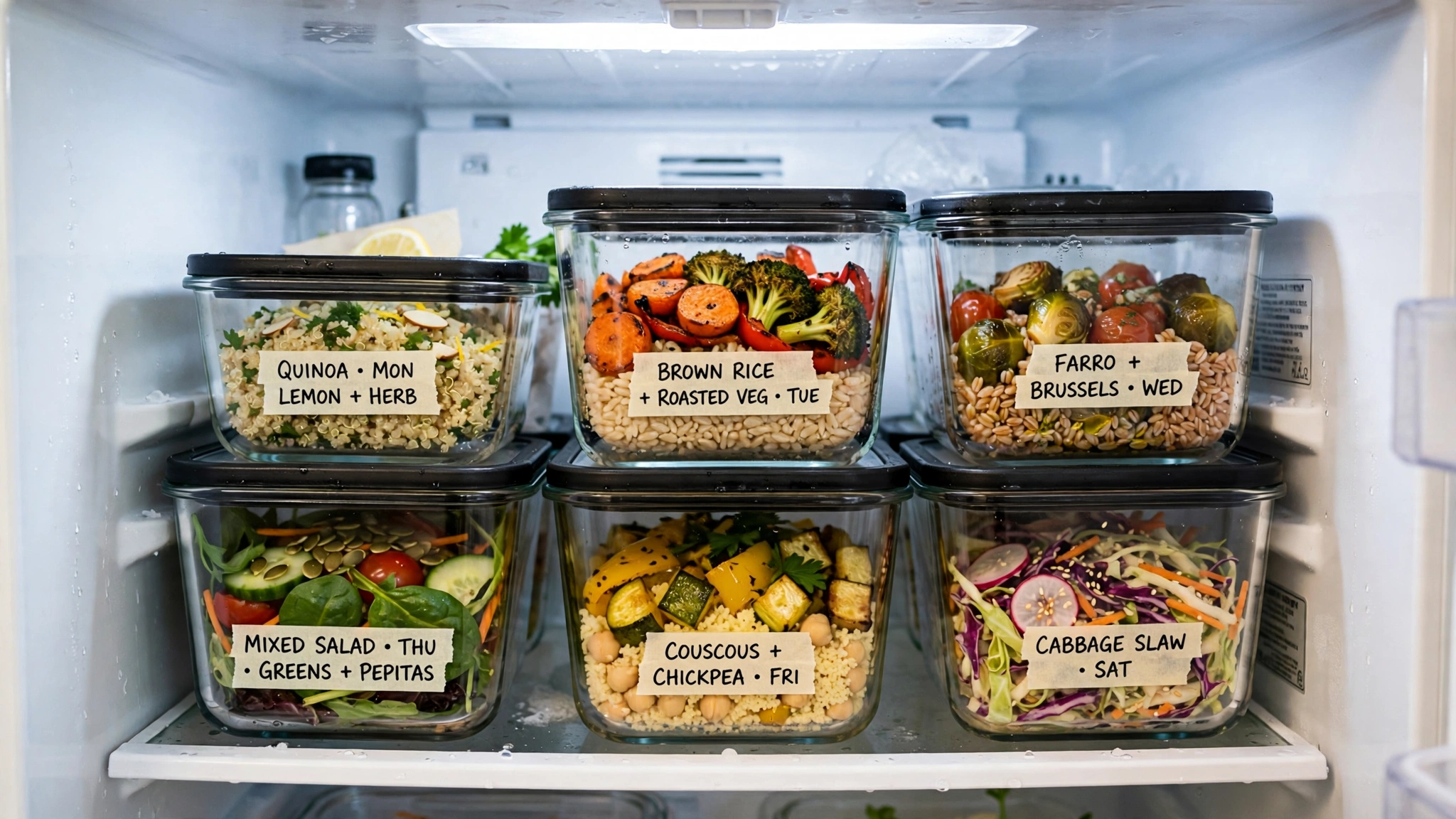
6. Switch to stackable glass containers. Square glass containers stack neatly, survive the microwave, and let you see what is inside without opening six lids. Buy one size for mains and one smaller size for sides and sauces. Two sizes cover almost every meal, and matching lids mean no more lid hunts.
7. Label everything with the date. Masking tape and a marker beat any fancy label system. Write the dish and the day it was made on every container, and eat the oldest first. A two-second label is the difference between lunch and a science experiment by Friday.
8. Give prepped food one dedicated shelf. One shelf, eye level, holds this week’s meals and nothing else. Raw ingredients live below it, condiments live on the door. When the shelf is empty you know you are out of meals, and when it is full you know the week is handled.
9. Prep ingredients, not just finished meals. Washed greens, chopped onions, cooked grains and marinated protein are the building blocks of five different dinners. A container of each takes less space than five finished meals and gives you far more choice. Cook the grain and chop the veg on Sunday, decide the actual dinner on the day.
10. Freeze a second batch in flat bags. Soups, stews and sauces freeze flat in zip bags, stacked like files in the freezer. They thaw in minutes under running water and turn a no-energy evening into a home-cooked one. Label the bag with the dish and the date, and lay it flat until frozen solid.

Tools That Earn Their Counter Space
A small kitchen cannot carry single-use gadgets. Every tool in the station has to earn its place by doing two jobs or saving real time.
11. Let a rolling cart be your mobile station. A narrow three-tier cart holds the board, bowls and containers, then rolls to the counter when you prep and tucks beside the fridge when you do not. At around forty dollars it is the most flexible station a renter can own. Lock the casters once parked or it will wander every time you lean on it.
12. Use a sheet pan as a prep tray. A rimmed sheet pan under your board catches juice and stray chop, and carries everything to the stove or the fridge in one trip. It also doubles as a roasting pan, which is how a tool earns its space. Line it with a tea towel and it becomes a drying rack too.
13. Keep one good chef’s knife and a peeler. A sharp eight-inch chef’s knife and a Y-peeler handle ninety percent of prep work. A knife block with eight dull knives does not. Keep the knife on the magnetic strip and the peeler in a small jar in the zone, and sharpen the knife every couple of weeks.
14. Store bowls nested in the zone. Three mixing bowls nested together take up the space of one, and a set of small prep bowls holds chopped ingredients while you cook. Clear glass bowls let you see what is prepped at a glance. Keep them in the zone, not in a high cupboard you need a chair to reach.
15. Add a small immersion blender. An immersion blender blends soup in the pot, whips dressings in a jar, and stores in a drawer. It replaces a bulky countertop blender for most renter cooking and costs less than a week of takeaway. Hang it on a hook inside a cabinet door when it is not in use.
Batch-Cook Like a Renter
Batch cooking sounds like a weekend project. In a rental it is really one pot, one pan and one hour, repeated with different seasoning.
16. Cook one grain and one protein, use them five ways. A pot of rice or quinoa plus a tray of roasted chicken or chickpeas becomes grain bowls, wraps, salads and stir-fries all week. Change the sauce and the herbs, not the base, and nobody feels like they are eating leftovers. This is the single highest-return hour in the whole system.
17. Roast a full sheet pan of vegetables. One hot oven, one sheet pan, whatever vegetables are in season. Roasted veg keeps five days in the fridge and goes into bowls, pasta, eggs and wraps. Cut pieces the same size so they cook evenly, and do not crowd the pan or they will steam instead of roast.
18. Make one sauce that fixes everything. A tahini lemon dressing, a peanut sauce or a simple salsa verde turns plain grains and veg into a meal worth eating. Make a jar on Sunday and it covers the week. Sauces are also the cheapest way to make the same base taste different on Wednesday than it did on Monday.
19. Portion meals while the food is still warm. Pack lunches the moment cooking finishes, not later when the food has cooled and the motivation has gone. Warm food packs neatly, portions come out even, and the fridge shelf fills itself. If you wait until after dinner, the leftovers stay in the pot and get thrown out on Friday.
20. Keep a freezer stash of emergency meals. Three flat bags of soup or stew in the freezer are your insurance policy for the week everything goes wrong. Rotate them so none sits longer than a month, and replace each one you use the next time you batch cook. Our small kitchen storage ideas for renters show how a small freezer can hold far more than it looks like it can.

Keep Your Meal Prep Station Working All Week
A station that only works on Sunday is a decoration. These last five ideas keep it alive through Friday.
21. Run a ten-minute reset every night. While dinner cooks, wash the board, wipe the zone and put the containers back where they belong. Ten minutes a night beats an hour of Sunday cleanup, and a clean zone is what makes Monday prep happen at all. Set a phone reminder until it becomes automatic.
22. Plan five dinners, not seven. Five planned meals leaves two nights for leftovers, eating out or whatever is actually in the fridge. Planning seven nights is how meal plans collapse on Wednesday. Five is honest, and honest plans survive contact with a real week.
23. Shop from a standing list. Keep a running list on the fridge and add items the moment you run out. Shop once, from the list, on the same day you prep. Impulse shops are what fill a small kitchen with duplicate jars and no actual dinner. The list is the plan, and the plan is the station.
24. Put herbs and greens where you can see them. A jar of water with fresh herbs on the windowsill, or a small pot of basil on the counter, lasts longer than herbs buried in the fridge drawer. Visible herbs get used, and used herbs make plain meals taste finished. Snip what you need while you cook and skip the garnish step entirely.
25. Review the week every Sunday, for five minutes. What ran out first, what went uneaten, what took too long. Adjust next week’s list and nothing else. The station gets better every week because you fix one small thing, not because you bought a new gadget. After a month it fits your life so well you will wonder how weeknights ever worked without it. If you want a matching project for the weekend, our small kitchen baking station ideas for renters use the same zone-and-routine thinking for baking, and the two stations share the cart, the bowls and the habit.

A good meal prep station is not a renovation and it is not a gadget collection. It is one clear counter, a set of matching containers, and a Sunday hour that pays for itself five times over. Start with the zone and the containers this weekend, add the cart and the routine next week, and let the system grow into the way you actually cook. For more ideas to pin and save, follow our boards on Pinterest, where every station on this site has its own board.
